
If you’re exploring E-Ink vs LCD Shelf Displays, you’ve probably encountered two options: e-ink (e-paper) displays and LCD digital signage. They both show dynamic content. They both sit on the shelf edge. But that’s where the similarities end.
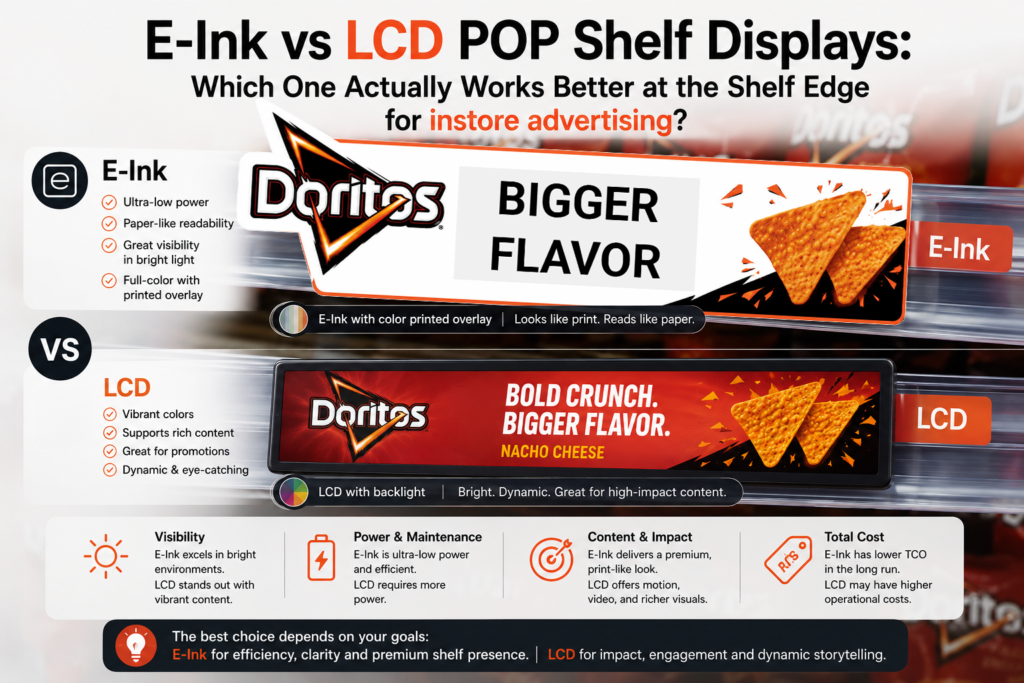
Here’s an honest breakdown of how they compare — and why the right choice depends on where and how you plan to use them.
1. Power: The Biggest Difference
| E-Ink Display | LCD Display | |
|---|---|---|
| Power Source | Coin batteries (CR2450) | AC power outlet |
| Battery Life | 6–18 months | N/A — requires constant power |
| Wiring Needed | None | Yes — power cables per unit |
What this means for you: E-ink displays are completely wireless. No outlets, no cables, no electrician visits. You can deploy them on any shelf — including end caps, refrigerated sections, and temporary promo racks — without worrying about power infrastructure.
LCD displays need a power source for every single unit. At scale (hundreds of stores), this becomes a serious logistics and cost challenge.
2. Visibility: It Depends on the lighting
E-ink uses reflected light, just like paper. It’s sunlight-readable with a 180° viewing angle and zero glare. Under bright retail lighting — which most stores have — e-ink looks crisp and clear from any angle.
LCD is backlit. It looks vivid in dim environments but washes out under direct light and has a narrower optimal viewing angle. Under harsh fluorescent or track lighting, the screen can become hard to read.
💡Bottom line: For well-lit retail shelves (which is most retail), e-ink is actually easier to read than LCD.
3. Content: Animation vs. Video
| Capability | E-Ink | LCD |
|---|---|---|
| Static images | ✅ | ✅ |
| Colored animations | ✅ (via printed film overlay) | ✅ |
| Full-motion video | ❌ | ✅ |
| Color range | Light tones work best — deep colors weaken the flash effect | Full color, full contrast |
E-ink uses a semi-transparent printed film layered on top of the e-paper to produce colored segments. The result: eye-catching, branded animations in color — not just black and white. However, because e-ink has no backlight, deeper and darker colors absorb more light and reduce the animation’s visibility — the flashing effect becomes less noticeable, making it harder to catch a shopper’s eye at a glance. Lighter tones — pastels, brand accent colors, bright highlights — reflect more light, produce stronger contrast, and deliver the shelf-stopping motion that drives impulse attention.
LCD offers full-spectrum color with backlight-driven contrast. It looks vivid even with dark palettes. But on a 2-inch shelf-edge screen, a well-chosen light color palette on e-ink often communicates just as effectively — with a fraction of the power consumption.
4. Total Cost: Look Beyond the Unit Price
LCD displays might seem comparable at first glance, but the true cost tells a different story:
| Cost Factor | E-Ink | LCD |
|---|---|---|
| Unit price | Moderate | Moderate to high |
| Power infrastructure | $0 | $5–15 per outlet install |
| Ongoing electricity | ~$0 | $2–5 per unit/year |
| Maintenance | Battery swap every 6–18 months | Screen burn-in, backlight failure |
| Deployment complexity | Peel, clip, done | Requires wiring per location |
5. Durability & Sustainability
| E-Ink | LCD |
|---|---|
| 3.7mm thin, shatterproof, flexible | Thicker, fragile glass panel |
| 98% less energy than LCD | Generates heat (problematic in enclosed shelf spaces) |
| No glass, no backlight, minimal e-waste | Backlight degrades over time |
| Works in cold environments (refrigerated shelves) | Higher carbon footprint per unit |
For brands with sustainability commitments — and most major retailers now do — e-ink is the clear winner on environmental metrics.
When Should You Choose LCD?
LCD is the right tool when you need:
- Full-motion video — product demos, brand storytelling loops
- Rich, dark color palettes — cosmetics, food photography, lifestyle imagery
- Indoor, controlled-light environments with existing power access
- Larger screen sizes (10″+ where e-ink options are limited)
When Should You Choose E-Ink?
E-ink is the right tool when you need:
- Wireless deployment at scale — no power, no hassle
- High visibility under bright retail lighting
- Long battery life with zero maintenance
- Low MOQ to test before committing
- Eco-friendly shelf communication
- Custom shapes that match your brand or product silhouette